Case study · Floatic · 2022–2024
Flody: keeping a warehouse fleet out of deadlock
Robots shared their poses and planned paths over a site-local bus and planned around each other. Fleet deadlocks went from 3–4 per hour to about one every two hours.
- Role
- Robotics Software and Platform Engineer
- Period
- 2022–2024
- Scale
- 10 robots, 3 sites
- Stack
- ROS 2, Nav2, Redis, Kafka, AWS IoT
The problem
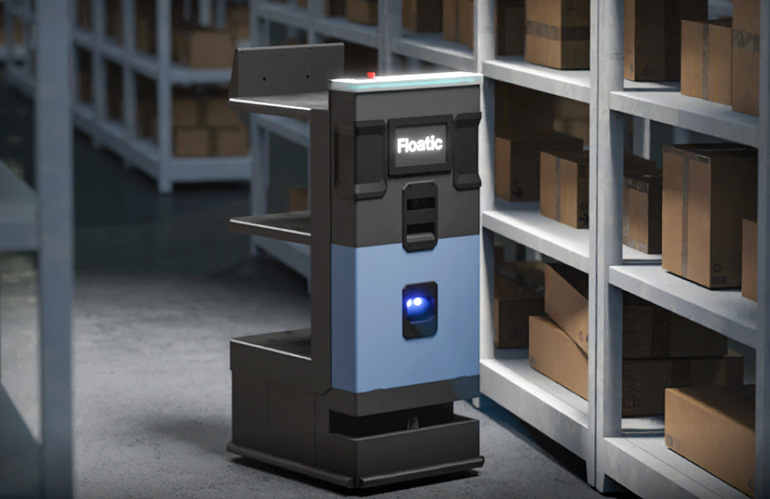
Flody robots carried goods through narrow warehouse aisles. When several robots needed the same aisle they blocked each other, and the fleet deadlocked 3–4 times every hour.
Before this work, a deadlock was cleared with an e-stop or by simple rule-based handling.
The approach
Coordination was decentralized. Each robot shared its own state with the fleet and planned around its neighbors.
- 1 Share Each robot published its pose and planned path on a site-local Redis bus.
- 2 Read neighbors Every robot read the poses and paths of the robots near it from the same bus.
- 3 Plan around Nearby robots were added to each robot's own local costmap before it planned.
Results
My part
At Floatic I built the navigation stack and middleware for the warehouse fleet.
- A DDS-style middleware layer that put robot–backend communication behind one interface, so Kafka and AWS IoT could be swapped without touching robot software.
- Multi-robot navigation on ROS 2 Nav2: cost functions for custom costmap layers, a Kalman filter correcting wheel odometry, and planner and controller tuning for dense warehouse aisles.
- Behavior-tree task execution backed by an edge database server that tracked the tasks allocated to each robot.
Press
Coverage of Floatic and its warehouse robot.
Jun 2024Floatic raises $3.8M for AMRs to tackle e-commerce picking
Nov 2024LogisALL doubles productivity in trial with Floatic picking robots
2024, Design ConceptFlody: Warehouse AMR
Jul 2022Warehouse robotics maker Floatic raises $2.6 million in pre-Series A
What it led to
Flody gave me a concrete version of the problem I now study: multi-agent path finding when many robots crowd into the same space. My two JKSPE papers look at MAPF in congested environments and continuous-time conflict-based search.
See publications on the home page